We use cookies to make your experience better. To comply with the new e-Privacy directive, we need to ask for your consent to set the cookies. Learn more.


Wi-Fi 6 (AX) Routers: Next-Gen Wireless Speed & Security

Wireless-AX (aka 802.11ax) represents a major innovation in WiFi technology.
Wireless-AX can transmit data wirelessly at rates of up to 14 Gbps, 4x its predecessor Wireless-AC. The new wireless standard promises optimized performance for streaming, more throughput, more efficient signal processing, and more.
Great for 4K, 8K streaming
New devices will come out that will be able to support these new Wireless-AX speeds, such as 4K and 8K video streaming. Sooner or later, these resolutions will be a staple in home entertainment, making Wireless-AX the only way to go in terms of home networking.
Higher WiFi power
The maximum raw data rate across an 802.11ax WiFi router is a whopping 14 Gbps compared to 3.5 Gbps for a similarly configured 802.11ac router. This massive improvement in wireless speeds meets the requirements for multiple-user video streaming and transferring huge files.
Optimized performance
With higher data rates, improved power efficiency, and increased capacity, WiFi6 allows for optimal performance in environments with many connected devices
Comparing Wireless-AX with Wireless-N, Wireless-G & Wireless-AC
- • Max throughput
- • Wireless-G - 54 Mbps
- • Wireless-N - 600-900 Mbps
- • Wireless-AC - 1200-5300
- • Wireless-AX - up to 14 Gbps
- • Wireless range (radius): 75 ft, 200 ft, 500 ft, 1000 ft
- • Wireless channel width: 20 MHz, 20/40 MHz, 20/40/80/160 MHz, 20/40/80/160 MHz
- • Wireless bands: one 2.4 GHz (single band), one 2.4 GHz & one 5 GHz (dual band), one 2.4 GHz & up to two 5 GHz (Tri-Band), one • 2.5 GHz & up to two 5 5Ghz (tri-band)
- • Wireless-AX offers the highest speeds for any compatible device
BEST SELLING WIRELESS-AX SOLUTIONS
Most Popular Wi-Fi 6 VPN Routers
-
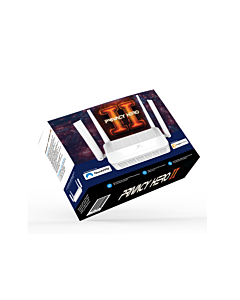 Privacy Hero 2 - Wireguard Support For Most Popular VPNsSpecial Price $149.99 Regular Price $249.99
Wireless-AX Features
- • OFDMA
- • Enhanced MU-MIMO capabilities
- • Throughput
- • 1024-QAM (Quadrature Amplitude Modulation)
- • Dynamic fragmentation
- •Spatial frequency reuse/OBSS
- • Advanced beamforming
- • TWT
- • Improved outdoor operation
INCLUDES OFDMA
WiFi 6 supports "Orthogonal Frequency Division Multiple Access" (OFDMA). A feature borrwed from LTE technology, OFDMA breaks up radio signals from a device into smaller sub-signals, allowing for simultaneous processing.

MORE MU-MIMO
Supports 8x8 stream MU-MIMO. Meaning, the router can deal with up to 8 devices simultaneously (as opposed to 1 with Wireless-AC). Integrate VPN on a router so that any device that connects can use VPN without individual device setups.

TARGET WAKE TIME
The router can communicate with client devices and tell them to sleep and wake. This allows for a longer battey life for client devices.

MORE SPECTRUM SUPPORT
In addition to the 2.4 GHz and 5 GHz bands, Wireless-AX will eventually support 1 GHz and 6 GHz bands.

Wireless-AX FAQs
Wi-Fi Predecessors
In 1985, the United States FCC opened up the wireless frequencies 900Mhz, 2.4Ghz, and 5.8Ghz to be used without a license. To make these frequencies usable for communication, the FCC mandated usage of spread spectrum technology over these bands. Around the same time as WiFi, WLAN (Wireless Local Area Network) technology emerged, but the technology was proprietary, so wireless devices from one manufacturer wouldn’t work with technology from another. However, in 1988, the NCR Corporation wanted a WLAN standard for use in their wireless cash registers and turned to Victor Hayes, author of many of their data transfer standards. Hayes, along with Bruce Tuch, a Bell Labs engineer, asked the Institute of Electrical and Electronic Engineers (IEEE) for assistance in utilizing these frequencies for a WLAN standard. A committee was created - with the incredibly catchy title “802.11” - to develop this standard. Nine years later, in 1997, the standard was published and named after the committee.
The Beginnings of Wi-Fi
The 802.11 standard was capable of transmitting data at a speed of only two megabits per second but was quickly enhanced. In 1999, a faster version called 802.11a was released, offering a speed of fifty-four megabits per second but with limited range and high production cost. Later in that same year, 802.11b was released, which brought Wi-Fi into the mainstream with its cheap production cost and greater range. The sudden popularity of wireless networking created a flood of new 802.11b hardware on the market, but there was no way to ensure compatibility between devices from different manufacturers. In 1999, a group of six companies banded together to create the Wireless Ethernet Compatibility Alliance, or WECA, an organization that aimed to test Wi-Fi equipment for compatibility. In 2002, they coined the term "Wi-Fi", combining "Wireless" and "Hi-Fi" (a term used in the music industry as an abbreviation of High Fidelity), and renamed themselves Wi-Fi Alliance.
Wireless-AC vs Wireless-AD
And Then There Was Wireless-N…
Wireless-N (802.11n) was released in 2009 and was the first to operate on two bands (2.4 GHz and 5 GHz), which explains the term dual-band router. What made Wireless-N significant is that it increased the maximum data transmission rate more than tenfold from 54 Mbps to 900 Mbps. Wireless-N also opened up additional spectrum area for wireless transmission, allowing for the use of four spatial streams in a channel width of 40 MHz. That is double the channel width of Wireless-G. 802.11n standardized support/technical specifications for multiple-input multiple-output (AKA MIMO). It also increased security and improved several additional features.
